|
|
The Fundamental Right of Medical Necessity
and Genetic Intervention
for Substance Abuse
William Kitchin
Department of Political Science
Loyola
College
Baltimore, MD 21210 USA
(wkitchin@loyola.edu)
Journal
of Evolution and Technology - Vol. 15 Issue
1 -February 2006 - pgs 1-21
http://jetpress.org/volume15/kitchin.html
 PDF Version
Abstract
Genetic intervention is on the near horizon for
the treatment of substance abuse. Genetic intervention involves a
reprogramming of a person’s own genetic instructions so that that
person will no longer have the physical craving for the drug of
choice. Unlike pharmacologic intervention, genetic intervention
will change the genetic identity of the person, albeit slightly.
The legal issue is whether one has a fundamental right to this
medical procedure. A fundamental right is one that the government
cannot deny without a compelling interest. The case law indicates
that the right of medical necessity applies when the person’s
affliction is serious, there are no reasonable or effective
alternatives, the person did not intentionally cause the
condition, and the treatment is effective for the long term.
Unlike the medical marijuana phenomenon, genetic intervention is
per se anti-drug, unrelated to illegal, recreational drug use, and
on its face has a medical use. Legal doctrines to date though not
directly on point are conceptually compatible with the existence
of a fundamental right of medical necessity for genetic
intervention.
The Lena Scenario
The following scenario is completely
fictitious but entirely plausible. Lena is a fourteen year
old. She first experimented with marijuana, and this has led
her to heroin. Ken, a sixteen year old, is already addicted
to heroin and has drawn Lena into his circle of drug buddies.
Lena is quite taken with Ken. He is, in her eyes, good
looking, exciting, and older. Plus, real drugs seem to be a
lot more fun than marijuana.
Lena’s parents are clueless. They went
through their teen years in another era and either do not
recognize the signs that Lena is a user or are in denial or
most likely both ignorant and in denial at the same time.
However, as Lena is transformed from a fun kid to a little
package of hate, the parents begin to wake up into their
nightmare. When they finally discover enough evidence that
Lena is using heroin that their denial is shattered, they
frantically seek advice. They learn that in today’s America,
they cannot force their little Lena to stay in a
rehabilitation program until she commits a crime, something
that to their knowledge she has not yet done. One counselor
encourages them to allow Lena to be arrested in possession of
heroin so that then she can be forced into taxpayer-financed
rehab through the American criminal justice system. Lena’s
mother, a juvenile court master, realizes that the primeval
American criminal justice system - for juveniles and adults
alike - would more likely harden Lena into a life on drugs
rather than help her get off drugs.
Another counselor informs the parents of
rehabilitation programs in Mexico where Lena could be made to
stay “until she graduates”[2].
The drawback here is that the medical insurance industry has
pretty much closed the door on effective rehab by the 30 day
rule.
Rehab requires an extended period of time, i.e., substantially
more than thirty days for most illegal drugs, to have any
chance of success.
Consequently, the 30 day rule appears to be a blatant
deception perpetrated by the insurance company on the
policyholder. Anyway, Lena’s parents are afraid to go the
Mexican route because they cannot overcome their fears and
prejudices about Mexican lawlessness, some adverse press
coverage of Baja rehab facilities, and the dangers of just
being American in Mexico.
Then the parents are put into contact with a
physician who is associated with one of the country’s leading
medical research institutions. The physician informs the
parents of what she calls “medical intervention”. She
explains that the grip which heroin has on Lena is maintained
because the sensations when using heroin are so “good”. It’s
so “good” that Lena wants more, more often. The physician
explains that the physical craving for more heroin is caused
by some neurochemical processes set into motion by the heroin,
and she explains that certain genetic “markers” are central to
the heroin-caused sensation of feeling so good. The physician
explains that these “markers” can be reprogrammed so that Lena
will not get the same sensations, indeed will get no real
sensations at all, and will, therefore, be no more drawn to
heroin than to flour or corn meal. In short, the parents are
presented with an option to deal with the physiological aspect
of heroin addiction, (though certainly not with the
psychological aspects which underlie so much addiction).
Lena is only fourteen. With some finesse,
the parents can make the decision for Lena to undergo this
medical intervention at the genetic level. There is no claim
that it cures addiction. The claim is that it diminishes the
physical dimension of addiction to the point that the
psychological aspects can be dealt with more successfully and
more aggressively.
The Patient’s Interest
The patient - in our scenario, Lena - has a
number of conflicting interests at issue. First, the patient
has a right to at least some level of personal autonomy. No
child is completely at the medical mercy of anyone else,
parents included. For example, a parent, absent medical
necessity, can hardly order a child’s kidney be taken out, but
a parent can order wisdom teeth to be extracted even though
there is no immediate medical necessity. Likewise, a parent
can make a decision for the child and against the child’s
wishes that the child receive speech therapy.
To which is the genetic intervention for
substance abuse more similar - a kidney operation, wisdom
tooth extractions, or speech therapy? Table One lists four
major “rights” inquiries which attach to involuntary medical
procedures. Three of the rights inquiries attach to any
medical treatment being considered for a minor who has not
given informed consent to the treatment. First, we ask
whether the treatment intrudes on the minor’s personal
autonomy. Most but arguably not all medical treatments
against one’s will violate one’s right to personal autonomy.
Table One: Four Rights Inquiries Implicated
by Involuntary Medical Treatment for
a Minor
|
Inquiry |
Leading
Judicial Case |
|
Does the treatment intrude on the minor’s
personal autonomy? |
No Case |
|
Does the treatment violate the minor’s
right to be free from physical intrusion? |
Winston v. Lee 470 U.S. 753 (1985) |
|
Does the treatment violate the minor’s
right to be free of conduct which shocks the conscience? |
Rochin v. California 342 U.S. 165
(1952) |
|
Do prohibitions by the government of the
treatment violate the minor’s right to medical necessity? |
U.S. v. Oakland Cannabis Buyers’
Cooperative 532 U.S. 483 (2001) |
Second, we ask whether the treatment violates
the minor’s right to be free of a physical intrusion into
one’s body. There are, of course, degrees of intrusion, and
the courts have allowed intrusion against one’s will, for
example, for the drawing of a blood sample, Schmerber v.
California, 384 U.S. 757 (1966) but not for the surgical
removal of a bullet which could be evidence of a crime,
Winston v. Lee, 470 U.S. 753 (1985).
A third question implicated by treating a
minor against his or her will is whether the treatment
procedure would “shock the conscience”. The formulation is
intrinsically subjective but recognizes that certain
procedures are so out of keeping with our notions of decency
that the government cannot force them on anyone because they
shock the conscience. This approach is expressed most clearly
in Rochin v. California, 342 U.S. 165 (1952).
A fourth inquiry, somewhat different from the
first three, is whether a law prohibiting a procedure which is
needed by the minor in a circumstance where another procedure
cannot reasonably accomplish the same medical result violates
the minor’s right to medical necessity. The philosophical
foundation here is that one has a natural right to successful
medical treatment and (a) unless there is an equally
successful medical alternative and (b) so long as the
treatment does not endanger another person, the government may
not prohibit that treatment. Thus, we allow narcotics to be
used to treat a cancer victim’s pain. Indeed, the degree to
which a society recognizes the right to medical necessity is
arguably an accurate gauge of the society’s devotion to
individual rights.
Table Two gives an admittedly subjective
rendition of various medical treatments in terms of the four
rights inquiries. Category one of Table Two includes medical
procedures which either do not infringe on the minor’s right
or infringe only minimally. Thus, if the minor has a speech
impediment, few would maintain that the minor, forced to
undertake speech therapy, had his or her personal autonomy
violated. There is no physical intrusion, and practically no
one would say that speech therapy shocks the conscience.
However, if the government were to prohibit speech therapy or
corrective glasses as a training regime for coping with
dyslexia, the right to medical necessity as that concept has
been developed by American courts would clearly be violated.
Table Two:
A Comparison of Various Medical
Procedures
|
|
If Done Against Will, Does It
Intrude on Personal Autonomy? |
If Done Against Will, Does It
Violate Freedom from Physical Intrusion? |
If Done Against Will, Does It Shock
the Conscience? |
Would Prohibition Violate the Right
of Medical Necessity? |
|
Category I |
|
|
Speech Therapy |
Minimally |
No |
No |
Yes |
|
Aggression Mgt. Therapy |
Minimally |
No |
No |
Yes |
|
Coping Skills for Dyslexia |
Minimally |
No |
No |
Yes |
|
Category II |
|
Glasses, Vision Correction |
Moderately |
No |
No |
Yes |
|
Psychoanalysis |
Moderately |
No |
No |
Yes |
|
Treatment for Wheat Allergy |
Moderately |
No |
No |
Yes |
|
Prescribing of anti-depressants |
Moderately |
No |
No |
Yes |
|
Category III |
|
Preventive Wisdom Teeth Removal |
Yes |
Yes |
No |
No |
|
Corrective Surgery for
Toe Alignment |
Yes |
Yes |
No |
No |
|
Category IV |
|
Kidney Removal |
Yes |
Yes |
No |
Yes |
|
Tonsils Removed |
Yes |
Yes |
No |
Yes |
|
Anthrax Inoculation |
Yes |
Yes |
No |
Yes |
|
Insulin for Diabetics |
Yes |
Yes |
No |
Yes |
|
Abortion to Save Mother’s Life |
Yes |
Yes |
No |
Yes |
|
Smallpox Inoculation |
Yes |
Yes |
No |
Yes |
|
Use of Marijuana
for Pain Management |
Yes |
Yes |
No |
Yes |
|
Genetic
Intervention for Parkinson’s Disease |
Yes |
Yes |
No |
Yes |
|
Genetic
Intervention for Substance Abuse
|
Yes |
Yes |
No |
Yes |
|
Category V |
|
Unnecessary
Stomach- Pumping |
Yes |
Yes |
Yes |
No |
|
Preventive Mastectomy |
Yes |
Yes |
Yes |
No |
|
Unnecessary
Cosmetic Surgery |
Yes |
Yes |
Yes |
No |
Category two includes those treatments which
intrude on personal autonomy more than category one
treatments, but the intrusions in category two are only
moderate. Thus, for example, if a minor has depression and an
anti-depressant is properly prescribed by a psychiatrist,
there is an invasion of the minor’s personal autonomy if the
minor is forced to take the medication involuntarily.
However, such an intrusion onto the minor’s personal autonomy,
though more than minimal, is nonetheless acceptable because
with rare exceptions (1) the alternative is less acceptable
and (2) the intrusion does not shock the conscience. One can
always create a scenario wherein involuntary administration of
an anti-depressant does shock the conscience - - -
e.g., when the particular anti-depressant is contra-indicated,
when it is not prescribed by a competent, psychiatrist, etc. -
- - and it is the resulting “shocks the conscience” aspect
which makes the intrusion on personal autonomy unacceptable.
Category three includes procedures which,
though intrusive, seem to fall short of shocking the
conscience. Thus, removing a child’s wisdom teeth where no
physical problems have occurred would not shock the conscience
but would arguably violate one’s right to be free of physical
intrusion. It is not the fact of physical intrusion but
rather the nature of the specific intrusion which determines
whether the conscience is shocked.
Category four includes among other medical
procedures genetic intervention for substance abuse. Along
with the other examples in the fourth category, this is one
where there is an intrusion on the minor’s personal autonomy,
and there is also a physical, bodily intrusion. Thus, for
example, if anthrax were to be widely used as a terrorist
weapon and government policy were to allow, but not require,
anthrax inoculations, even given the apparent side effects of
that serum and the unknowns surrounding it, few would maintain
that within the prevailing circumstance of a domestic
terrorist threat the inoculation of an unwilling thirteen year
old shocks the conscience or is an unacceptable invasion of
personal autonomy. Because it does not shock the conscience,
it is an acceptable intrusion on personal autonomy.
Practically any medical treatment violates one’s personal
autonomy, even it only minimally. What determines whether the
violation is acceptable is whether, given the circumstances,
the violation is contrary to our notions of decency,
propriety, and civilized conduct as those notions have been
developed over the years. If the violation is contrary to
those notions, then it is not acceptable. It shocks the
conscience.
Category five is provided simply to give some
comparative context and to identify that medical treatments
can exist which so shock the conscience that regardless of the
circumstances they are unacceptable violations of one’s
personal autonomy. For example, there are some reported
incidents of parents opting for preventive mastectomies on
their children when breast cancer has run in the family.
Though not clinically indicated for the child, there might be
family history indications, but, nevertheless, most would
agree that such preventive mastectomies do shock the
conscience.
Likewise, numerous unnecessary or
experimental treatments might shock the conscience, though for
very different reasons. The unnecessary treatment
administered against a minor’s will is simply a per se
violation of the minor’s right to personal autonomy.
Therefore, unnecessary cosmetic surgery on a minor’s face or
body - - - which if it is against the minor’s will would
probably be for the parents’ vanity - - - would so shock the
conscience that it would be an unacceptable violation of the
minor’s personal autonomy.
An experimental procedure presents a
different problem. Assuming that some treatment is necessary
and that traditional treatments do not work, one might elect a
procedure which holds promise but has unknown side effects and
a somewhat unknown success rate. Here the calculus is not so
much whether the procedure shocks the conscience because it is
engaged in for non-therapeutic or per se unacceptable
reasons. Instead the calculus is whether the potential
benefits can reasonably be expected to outweigh the possible
costs, given the context that there is no alternative
treatment which holds a reasonable expectation of achieving
the same results the experimental treatment can reasonably be
expected to achieve. The experimental procedure does not
shock the conscience if the anticipated benefits clearly
outweigh the anticipated costs.
The Institutional Context for a Policy
of Genetic Intervention for Substance Abuse
For the medical treatments listed in Table
Two or for other analogous treatments, authoritative policies
have been made by the federal government, state governments,
or the people directly through initiatives and referenda, or
in some cases all of the above. For example, the federal
government threatened to prosecute medical marijuana users in
California because use of that substance violated federal
criminal laws even though California had legalized the medical
use of marijuana. In Gonzales v. Raich, 125 S.Ct. 2195
(2005), the U. S. Supreme Court ruled that the federal
government prevails in this state-versus-federal controversy
apparently because the majority was of the opinion that the
Constitution gives the federal government the power to
regulate anything which even speculatively affects more states
than one. The Court’s expansive ruling was based purely on
the commerce clause and did not mention the right of medical
necessity nor was medical necessity even argued.
The plethora of various state policies and
judicial opinions on medical marijuana stand in contrast to
genetic intervention for substance abuse. On that topic there
is no specific government policy at either the federal or
state levels.
The Congress
Congress is particularly ill-equipped to make
policy on genetic intervention for substance abuse because the
issue is so technical and because just about any conceivable
policy has potential ideological triggers which probably
preclude meaningful Congressional action in the first place.
On the one hand, a policy restricting genetic intervention
foregoes a major weapon in the so-called war on drugs and
arguably violates the fundamental right to medical necessity.
The pharmaceutical, medical, civil liberties, and “people”
interests could probably block definitive Congressional
action.
On the other hand, a policy endorsing genetic intervention
would likely antagonize the religious fundamentalists who
currently have such power over the national Republican party
that a Congressional majority endorsing genetic intervention
could probably not be assembled. “If God wanted those genetic
markers turned off, he would never have turned them on” will
echo through the chambers of Congress.
Perhaps the best indication of the danger of
Congress’s making policy on this issue for the foreseeable
future is that two large restraints on Congress are largely
absent on the topic of genetic intervention. Missing are (1)
a clear public opinion on genetic intervention
and (2) a clear signal regarding a policy on genetic
intervention from the moneyed interests which are so critical
to the financing of congressional elections campaigns.
Table Three gives a classification of
Congress’s making of “new” policy, that is, policy on a topic
addressed either only minimally or not at all in the past. If
the anticipated public reaction is substantial, the prediction
is that Congress will most likely make policy in the direction
of that anticipated reaction. If there is sure to be
substantial reaction, but the direction of that reaction
cannot be predicted with confidence, the prediction is that
Congress will not act at all.
Table Three: Congress’s Making Policy in a New
Area Anticipated Public Opinion
Reaction
|
Direction of
Public Opinion |
|
Substantial Reaction |
Minimal Reaction |
|
Positive Public Opinion Reaction |
Quick Action Per Public Opinion
Definitive Policy |
Quick Action/Either Direction |
|
Negative Public Opinion Reaction |
Quick Action Per Public Opinion
Definitive Policy |
Quick Action/Either Direction |
|
Direction of Public Opinion Reaction
Unknown |
No Definitive Policy |
No Definitive Policy |
Congress can act swiftly and, unleashed from
public opinion, in any reasonable direction if the public
reaction is anticipated to be inconsequential. Congress can
withstand a slight negative public reaction. It takes more
than that to affect a Congressperson’s vote unless the
particular Congressperson is cursed with one of those rare
competitive seats in which case that Congressperson may well
still be on the public leash.
Genetic intervention policy seems today to
fit best in the final cell of Table Three. Because a
relatively small percentage of the population will be directly
or immediately affected by any genetic intervention policy,
public reaction for the foreseeable future will probably be
inconsequential, at least initially. Whether the public will
initially support or oppose a particular policy (this concerns
the direction of public opinion) is unknown. However, the
chances are outstanding that the religious right will make an
endorsement of genetic intervention politically risky for a
large number of Congresspersons and Senators. Consequently,
we can expect Congress either to pass no laws at all on the
issue or to pass equivocal or meaningless laws. This is the
“punt and let the courts handle it” option.
When Congress is unleashed from a well-formed
public opinion but under the potential leash of powerful
interests, Congress can be expected to act with great
hesitation. The leash for Congress serves both as a guide and
as a restraint, and in these circumstances (unformed public
opinions and potential opposition from moneyed interests),
Congress treads ever so unboldly. Without something analogous
to the boogeyman of human cloning, genetic intervention will
be difficult to oppose because it promises to be therapeutic.
Moreover, it seems likely that genetic intervention will not
stoke the fires of religious groups’ murderous wrath as easily
as reproductive cloning or stem cell research.
The Courts
Like so many other issues, ranging from all
kinds of privacy issues to all kinds of personal autonomy
issues, the issue of genetic intervention for substance abuse
will most likely play out in the courts.
When properly presented to a court of competent jurisdiction
as a justiciable issue, the issue will likely involve due
process, privacy, and personal autonomy. Of the dozens of
legal doctrines which govern those areas, few seem suitable or
directly applicable to the issue of genetic intervention.
Only three seem to me to be on point - - - the “shocks the
conscience” doctrine articulated most eloquently in Rochin
v. California, 342 U.S.165 (1952), the “physical
intrusion” doctrine of Winston v. Lee, 470 U.S.753
(1985), and the fundamental right of medical necessity which
several state courts have recognized but which the U.S.
Supreme Court has never discussed as such. Though the Supreme
Court has discussed the criminal defense of medical necessity,
that is not the same thing as the fundamental right of medical
necessity.
Would Denial of Genetic Intervention
“Shock the Conscience?”
“This is conduct that shocks the
conscience”. Rochin v. California, 342 U.S.165, 172
(1952). Thus wrote Justice Frankfurter in explaining why the
police could not pump a suspect’s stomach against his will in
order to retrieve evidence which he had swallowed. Conduct
which shocks the conscience is conduct which “offends those
canons of decency and fairness which express the notions of
justice of English-speaking peoples....” 342 U.S., 169.
Though the context of Rochin is on the surface criminal
procedure, Frankfurter makes clear that the issue is human
rights, not just criminal procedure and that we have certain
rights which though not precisely listed anywhere are
nevertheless rights for which we retain protection from
government intrusion: “In dealing not with the machinery of
government but with human rights, the absence of formal
exactitude, or want of fixity of meaning, is not an unusual or
even regrettable attribute of constitutional provisions.” 342
U.S., 169. The due process clause of the fourteenth
amendment, therefore, contains certain substantive rights
beyond those rights explicitly mentioned in the Constitution
which government must observe. See generally Bowers v.
Hardwick, 478 U.S. 186, 191, 106 S. Ct. 2841, 2844, 92
L.Ed.2d 140 (1986); Hewitt v. Helms, 459 U.S. 460, 466,
103 S.Ct. 864, 868-69, 74 L.Ed.2d 675 (1982); Moore v. City
of East Cleveland, 431 U.S. 494, 503, 97 S.Ct.1932,
1937-38, 52 L.Ed.2d 531 (1977).
The “shocks the conscience” doctrine is
controversial because of its inherent subjectivity. It is a
per se contradiction of the idea that principles control the
outcomes of judicial cases. Though some judges and many
academics might reject, even ridicule, the doctrine, the
doctrine is alive and well in the courts. Since 2000, my own
electronic search reveals that it has been cited in 2178 cases
and is used as a controlling concept in many of those cases!
Obviously, the doctrine flourishes in the jungle of judicial
output. Though some read the “shocks the conscience” doctrine
as license for judicial activism (and it may well be) and
others decry its unavoidable subjectivity, the doctrine has
spread to areas of law other than police misconduct. For
example, the doctrine is now routinely a part of the analysis
in assessing whether damage awards are excessive (See for
example Carter v. Cox Cable, New Orleans, 806 So.2d 24
(2001); Layne v. Wal-Mart Stores, Inc., 24 Fed. Appx.
364, 2001 WL 1480736 (6th Cir. 2001) (not selected
for publication in the Federal Reporter) and whether criminal
sentences are proportional to the crime committed (See for
example Humetrix, Inc. v. Gemplus S.C.A., 268 F.3d 910 (9th
Cir. 2001); Miskovsky v. State, 31 P.3d 1054 (2001);
Perryman v. State, 990 P.2d 900 (1999). The doctrine has
also been applied in a number of situations where a specific
legal principle may not control but a general notion of what
is fair, decent, and civilized, nonetheless, is arguably
implicated, such as involving the alleged use of excessive
force by the police, Ferrante v. Peters, 2005 WL
1432740 (6th Cir.(Ohio)), 2005 Fed. App. 0521N (Not selected
for publication in the Federal Reporter), a principal pushing
a student, Gottlieb ex rel, Calabria v. Laurel
Highlands School Dist., 272 F.3d 168 (3rd Cir.
2001), government intimidation of agency employees into unsafe
work performance, Eddy v. Virgin Island Water and Power
Auth., 256 F.3d 204 (3rd Cir. 2001), the terms
of an arbitration agreement, Ferguson v. Countrywide Credit
Industries, Inc., 2001 WL 867103, 86 Fair Empl. Prac. Cas
354 (C.D. Cal. 2001), and the propriety of a tax sale on a
taxpayer’s property, Kabakjian v. U.S., 92 F. Supp.
2d435 (E.D.Pa. 2000).
All of these examples involve allegations of
government’s denial or violation of a particular right which
is not explicitly set forth in the Bill of Rights but is an
implicit substantive right protected by the due process clause
of the fourteenth amendment. A denial of genetic intervention
would in like manner implicate a right of medical necessity,
and in spite of an unusual and awkward 2001 case by the
Supreme Court,
medical necessity is exactly the type of issue which seems
very likely to trigger a shocks the conscience inquiry.
Would Denial of Genetic Intervention
Violate the Right of Medical Necessity?
If a defendant in a criminal case faces a
Achoice
of evils@
wherein obeying the law produces a greater harm than
disobeying the law, then that defendant might be able to argue
a general defense of “necessity”. The defense of necessity
has been part of the Anglo-American legal tradition since as
far back as 1551.
The medical necessity defense is a special variant of the
general necessity defense and is characterized by the
following elements:
The defendant did not intentionally bring about
the medical condition which is being addressed by the medical
action in question.
An alternative treatment is not available to the
defendant.
The harm caused by engaging in the medical
action is less than the harm caused by obeying a law or court
order prohibiting the action.
The medical necessity defense has been used
in various jurisdictions in the United States, but
unfortunately (or fortunately, depending on one’s point of
view!) many of the cases have involved claims that marijuana
was a medical necessity such as to justify violation of
various marijuana-related criminal laws. A
few examples can illustrate medical necessity claims.
The sixth Circuit assumed that the defense of medical
necessity was a viable defense but in the circumstances of the
case, the defense was not available. U.S. v. Burton, 894 F2d 188
(1990). It seems that the defendant, claiming that he needed
the marijuana to treat his glaucoma, must have had one bad
case of glaucoma since he had enough marijuana to be charged
with intent to distribute. A Florida court recognized the
defense and reversed a conviction for using marijuana to treat
nausea associated with AIDS, Jenks v. Florida 582 So.2d
676 (1991). Washington courts also have recognized the
defense. In State v. Pittman, 943 P.2d 713
(1997), the defendant used marijuana to treat the pain
associated with cancer. Though he did not successfully
satisfy the elements of the defense, the court did not
question the existence of the defense. However, in the year
following that case, the Washington court held that the state
legislature had put the defense out of bounds for possession
of marijuana. Medical necessity is a common law defense and
as such can be made unavailable by the legislature within a
statutory scheme. The Washington state legislature had
decided that marijuana had “no accepted medical use.”
State v. Williams, 93 Wash. App. 340, 347 (1998).
Minnesota courts reached the same result. State v.
Corrigan, 2001 WL 881394 (Minn. App.).
Two non-marijuana cases have also recognized
the medical necessity defense. In Minnesota, the court
observed that sterilization by vasectomy was prohibited in
several states, but that the statutes of those states allowed
for a medical necessity exception. Christensen v. Thornby,
255 N.W. 620 (1934). More recently, New York found that the
distribution of hypodermic needles to prevent the spread of
AIDS was a viable medical necessity defense to the criminal
possession of a hypodermic instrument. People v. Bordowitz,
588 N.Y. S.2d 507 (1991). The point is that the medical
necessity concept is well entrenched in American law.
In 2001, the U.S. Supreme Court issued its
first opinion ever on the medical necessity defense in U.S.
v. Oakland Cannabis Buyers’ Cooperative, 532 U.S. 483
(2001). In 1996, California passed an initiative legalizing
the possession and cultivation of marijuana for medical
purposes. The Oakland Cooperative served as a marijuana
dispensary for qualified patients. However, the U.S. Congress
has classified marijuana as a Schedule I substance, meaning
that Congress voted that marijuana has no accepted medical
use, 21 U.S.C.
'
841(a)(1), and cannot be possessed or distributed except as
part of a government-approved research project
'
823(f). Therefore, the federal government sought an
injunction to close down the Cooperative’s distribution
program even though under California law the program was
legal.
The majority opinion written by Justice
Thomas contains far-reaching dicta and some sleight of hand
which actually obscures a relatively narrow holding. The
Court held only that since Congress had considered exceptions
to the illegality of distributing Schedule I drugs and opted
against a medical necessity exception, the Court did not have
the power to unmake Congress’s decision and create a medical
necessity exception. Therefore, the Government’s request for
an injunction against the Cooperative was granted. This is
simply an application of a recognized aspect of the defense of
medical necessity, namely that the legislature can make a
defense unavailable within a statutory framework.
Significantly, the Supreme Court did not
address one rather narrow and one rather broad issue. The
narrow issue is whether there is a medical necessity defense
for possession. Cooperative concerned only
distribution. As Justice Stevens noted in a concurring
opinion, a court might reach a different result within a
possession framework:
Because necessity was raised in this case as a defense to
distribution, the Court need not venture an opinion on whether
the defense is available to anyone other than distributors.
Most notable, whether the defense might be available to a
seriously ill patient for whom there is no alternative means
of avoiding starvation or extraordinary suffering is a
difficult issue that is not presented here.
Stevens, conc., 532 U.S., 501.
However, a constitutional right of
medical necessity is more inclusive and far-reaching than a
statutory defense, and the broader issue which the Court
did not address is whether there is a fundamental
constitutional right of medical necessity. Congress has
the power to withhold a defense from its statutory regime, but
there may be a more fundamental right which Congress
can regulate only if it has a compelling interest.
Generally, Congress may regulate controlled
dangerous substances in any way which is rational and
consequently may conclude that marijuana is a Schedule I drug
and has no accepted medical use. Though that finding,
especially given its absoluteness (no accepted medical
use), may be wrong, the reasonableness approach used by the
courts requires only that the finding be rational, that it
make sense. Surely Congress’s finding is plausible as
demonstrated by the breadth of disagreement among medical and
pharmaceutical experts.
However, this so-called rational basis test
does not apply when Congress is regulating fundamental
rights. Instead of having just a rational reason,
Congress must have a compelling reason before it can
regulate fundamental rights. There is a very strong case to
be made, as Justice Stevens implied in the portion from his
opinion quoted above, that there may well exist a time when
the law cannot mandate the withholding of a treatment.
When considering genetic intervention, it is
probably more productive to think of medical necessity as a
right rather than as a defense. As in Rochin, the
stomach pumping case, we have certain rights which government
simply cannot take away absent compelling reasons. In
Rochin, it is the right to be free of government conduct
which shocks the conscience, or to phrase it differently, the
right to bodily integrity. For genetic intervention, the
fundamental right involved is the right of medical necessity.
Whether our law recognizes such a fundamental right has not
yet been determined, but without digressing into a detailed
discussion, one can construct a powerful argument that such a
fundamental right does exist.
The Stevens quote from his concurring opinion
in Cooperative contains two elements which make for the
fundamental right of medical necessity:
The patient’s illness must be serious.
There are no alternative means of avoiding
extraordinary suffering.
To these, a third might be added:
The patient must not have intentionally brought
about the condition to be treated.
Fundamental rights are not absolutes. With a
compelling reason, government can proscribe and limit those
rights. The following unknowns of genetic intervention might
serve to limit genetic intervention when it first begins to be
considered as an option in addressing drug abuse:
The degree of intrusion into one’s personal
autonomy..
The undesirability and unforeseeability of side
effects.
The effects on physiological and psychological
factors other than the patient’s desire for the targeted drug.
The long term effectiveness of the treatment.
Would Genetic Intervention Be So
Physically Intrusive as To Compromise Bodily Integrity?
In the context of criminal procedure the
courts have placed limits on the government’s power to intrude
into one’s body. Though genetic intervention is an entirely
different context from criminal law, at least as presented in
the Lena scenario above, the physical intrusion cases are
instructive as to the courts’ probable willingness to allow an
experimental procedure for an unwilling minor (and if for an
unwilling minor, why not as a condition of probation for a
recidivist drug offender?).
In Winston v. Lee, 470 U.S. 753
(1985), the U.S. Supreme Court held that the government cannot
order the surgical removal of evidence from a nonconsenting
suspect, but the holding was limited to the particular
circumstances of that case.
The court noted that whether the government may intrude into
the privacy of one’s body involves a weighing of a number of
factors. These factors are listed in Table Four along with
analogous application of those factors to the Lena scenario.
Table Four: Physical Intrusion Factors from Winston v.
Lee and the Genetic Intervention Scenario
|
Factor To
Be Considered |
Surgical
Removal of Bullet
(Winston v. Lee) |
Genetic
Intervention for Drug Abuse (Lena Scenario) |
|
Is the
end goal probably achievable? |
Yes,
there was notable cause to conduct the surgical search.
(470 U.S., 763). |
Yes, the
genetic markers associated with the desire for opiates
have been identified but their interactions are unknown. |
|
Has a
court had opportunity to review the medical and legal
questions involved? |
Yes, (470
U.S., 763). |
No. The
setting would be similar to Winston v. Lee in
that someone with standing would seek a court order
prohibiting the genetic intervention, and this would
lead to an airing of the issues. |
|
What is
the threat to the subject’s health and safety? |
“The
medical risks of the operation, although apparently not
extremely severe, are a subject of considerable
dispute.” (470 U.S., 766). The dangers were a threat
of infection from the incision, muscle damage, nerve
damage, and damage to the pleural cavity because of the
location of the bullet. |
The
dangers are unknown. The markers which are associated
with heroin addiction could also be associated with
other human behaviors and attitudes and those aspects of
the individual=s
behavior could be deleteriously affected. Reversibility
of genetic intervention is an open question. |
|
To what
extent does the procedure intrude upon the subject’s
personal privacy and bodily integrity? |
“... the
intrusion on respondent’s privacy interests can only be
characterized as severe.” (470 U.S., 766). The
severity of the invasion of privacy results from the
fact that it is physical and surgical. The Supreme
Court, quoting from the Court of Appeals said that the
government “proposes to take control of the respondent’s
body, to drug this citizen... with narcotics and
barbiturates into a state of unconsciousness, and then
to search beneath his skin for evidence of a crime.”
(470 U.S., 765). |
The
intrusion of genetic intervention is not so much an
invasion of privacy as it is an invasion of one’s
personal identity. If a person has a great desire, even
a debilitating desire for a drug of choice, who are we
to change who that person is that is, to
slightly reconfigure that person into someone who no
longer has the intense desire for the particular drug?
This is a personal autonomy, personal identity issue
more than a privacy issue. |
|
How
compelling is the need to use the procedure? |
The state
needed the bullet to prove which gun it was fired from,
but that need was not compelling because the state had
substantial other evidence which could prove the crime
beyond a reasonable doubt. (470 U.S., 765). |
Inside of
the United States, Lena as a minor cannot be forced to
stay in a drug rehabilitation program. If (1) expert
testimony was that there was little hope for her to beat
the addition - or to stay alive - without some kind of
procedure and (2) a court concluded that the personal
and social costs of her addiction were substantial, then
a court might well conclude that the need for the
procedure, even given unknown side effects, outweighs
the individual’s right not to have the procedure. |
The core distinction of
Winston v. Lee from a genetic intervention scenario are
that (1) Winston v. Lee was surgically invasive, (2)
involved some disagreement about known and not easily
reversible risks, and (3) involved a result which could be
achieved without the violation of the right to privacy. In
contrast, the Lena scenario involves (1) more of an invasion
of one’s identity and autonomy than of one’s physical body,
(2) unknown risks, and (3) a result which may not be
achievable without genetic intervention.
The Personal Autonomy Issue
Requiring a minor child to undergo a genetic
intervention indeed may involve an insurmountable
constitutional barrier. First off, children do have
constitutional rights of personal autonomy independent of
their parents. Whalen v. Roe, 429 U.S. 589 (1977).
Therefore, though the parents’ choice may be for genetic
intervention, their choice will likely be subject to a
judicial hearing (unless the intervention were to be carried
out in such a way that the judicial process was bypassed, and
this would arguably be criminal if it were done on American
soil). In another context, a 1995 U.S. district court had
occasion to give a convincing listing of precedents on which
an argument to prevent genetic intervention could be built:
In 1990, the Supreme Court
unequivocally held that the “forcible injection of medication
into a nonconsenting person’s body represents a substantial
interference with that person’s liberty.” Washington v.
Harper, 494 U.S.210, 229, 110 S.Ct. 1028, 1041, 108
L.Ed.2d 178 (1990). Still, other cases support the
recognition of a general liberty interest in refusing medical
treatment. Riggens v. Nevada, 504 U.S. 127, 112 S.Ct.
1810, 118 L.Ed.2d 479 (1992) (forced administration of
antipsychotic medication during trial violated Fourteenth
Amendment); Youngberg v. Romeo, 457 U.S. 307, 315, 102
S.Ct. 2452, 2457-58, 73 L.Ed.2d 28 (1991) (government has duty
to protect involuntarily committed mental patients from
physical assault); Winston v. Lee, 470 U.S. 753, 105
S.Ct. 1611, 84 L.Ed.2d 662 (1985) (surgical intrusion into
attempted robbery suspect’s chest to recover bullet without
compelling need unreasonable under Fourth Amendment where
surgery would place suspect at risk of adverse side effects);
Vitek v. Jones, 445 U.S. 480, 494, 100 S.Ct. 1254,
1264, 63 L.Ed.2d 552 (1980) (transfer to mental hospital
coupled with mandatory behavior modification treatment
implicated liberty interests); Parham v. J.R., 442 U.S.
584, 600, 99 S.Ct. 2493, 2503, 61 L.Ed.2d 101 (1979) (A[A}
child, in common with adults, has a substantial liberty
interest in not being confined unnecessarily for medical
treatment@);
Whalen v. Roe, 429 U.S. 589, 97 S.Ct. 869, 51 L.Ed.2d
64 (1977) (Constitution protects personal autonomy “in making
certain types of important decisions”); Schmerber v.
California, 384 U.S. 757, 772, 86 S.Ct. 1826, 1836, 16
L.Ed.2d 908 (1966) (“The integrity of the individual person is
a cherished value of our society”); Rochin v. California,
342 U.S. 165, 171, 72 S.Ct. 205, 209, 96 L.Ed. 183 (1952) (the
forcible extraction of stomach contents shocks conscience and
violates due process). See also Cruzan v. Director,
Missouri Department of Health, 497 U.S. 261, 278, 110 S.Ct.
2841, 2851, 111 L.Ed.2d 224 (1989) (Fourteenth Amendment has
been held to include medical decision-making, reflecting the
“principle that a competent person has a constitutionally
protected liberty interest in refusing unwanted medical
treatment.”)
In re Cincinnati Radiation Litigation,
874 F.Supp. 796, 812 (S.D. Ohio 1995). Though these cases
concern government’s attempts to invade a person’s bodily
integrity, American tort law includes the same basic
protections against other persons, including a minor’s own
parents. The individual is protected primarily by the
operation of informed consent, without which the procedure is
usually tortious:
Under the tort construct, absent an
emergency or incompetency, the individual must voluntarily
consent before medical treatment may be administered, and the
physician is required to provide sufficient information so
that the consent is informed. It is patently clear that the
premise of the informed consent doctrine is the “concept,
fundamental in American jurisprudence, that the individual may
control what shall be done with his own body.” Canterbury
v. Spence, 464 F.2d 772, 780 (D.C.Cir.1972), cert.
denied, 409 U.S. 1064, 93 S.Ct. 460, 34 L.Ed.2d 518
(1972).
874 F.Supp., 817.
The right to bodily integrity is as close as
the precedents get to a right of personal autonomy and the
related right of personal identity. Since the right of
personal autonomy is not an absolute, a balancing of the right
of personal autonomy on one hand against the benefits obtained
by doing the procedure on the other is metaphorically the
approach taken by courts. Winston v. Lee, 470 U.S.,
760.
The Physiological Results from Genetic
Intervention
At great risk of some oversimplification,
drug abuse problems in full bloom addiction (as opposed to
occasional use where a person’s life is not adversely
affected) have two main dimensions of disability, the
physiological and the underlying psychological. Of course,
there are all kinds of physiological aspects to drug addiction
but one common to all drug addictions is the organic call in
the brain for more of the “good feeling” associated with the
drug of choice. Likewise, there are a myriad of psychological
and psychiatric aspects of drug addiction, and they usually
exist prior to the onset of the drug use (and are often
causally related to the illegal drug use) though drug usage
may modify them. Likewise, those underlying psychological
aspects will influence certain of the drug-related choices
such as which drug to use, how often to use it, what to mix it
with, how to administer it, etc., but will apparently not
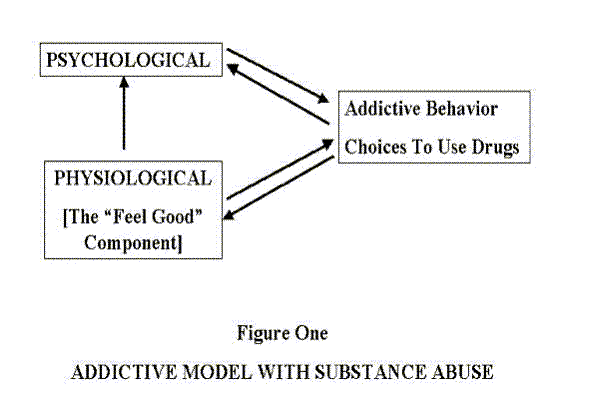
affect the biochemistry of the addiction. Figure One
illustrates the relationship between the physiological and the
psychological dimensions of drug addiction. The point of this
digression is to note that genetic intervention relates
primarily to the physiological dimension and only incidentally
to the psychological.
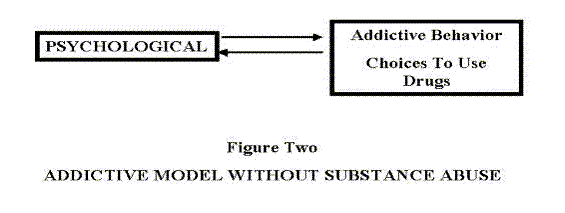
 Genetic intervention is a
means of essentially eliminating the physiological variable
from the addiction model so that the non-genetic therapy (for
example, talk therapy) can focus more successfully on the
underlying psychological variables. The neurophysiology
of addiction - of the “feel good” aspect of certain
drugs - is simply so strong that it often makes it impossible
for the user to deal with the psychological issues which led
to the addictive behavior in the first place.
Thus, genetic intervention does not cure addiction, but it
makes a successful therapy more obtainable. It simplifies
(but does not make simple!) the therapeutic challenge so that
it resembles Figure Two rather than Figure One.
Specifically the neurophysiology of heroin
addiction involves most prominently the μ- opioid receptor in
the ventral tegmental area and in the nucleus accumbens.
Our knowledge of events at the receptor level is still
limited, but apparently δ- and κ- receptors are also involved
in the craving for heroin.
Our knowledge of the neurochemistry is similarly limited, but
we do know that heroin triggers an increased release of
dopamine in the nucleus accumbens.
These findings are from animal studies. Because of advances
in human genetics, transferral to humans on the cellular and
molecular levels have in other areas such as Alzheimer’s
disease been smooth enough that pending a few more years of
study we can reasonably expect the findings from animal
studies to apply closely to humans.
We are not at the place today (2005) where
genetic intervention is possible. But in 5 or 10 years we
will be there,
and 5 or 10 years appears to be the outside time frame. With
the acceleration of discoveries in this area and with certain
advantageous peculiarities of substance abuse studies,
genetic intervention for substance abuse will in all
likelihood be possible well before 2015.
This discussion has looked at genetic
intervention only within a scenario involving a minor child
addict. In that scenario, the fundamental right of medical
necessity appears to be the heart of the issue.
The shocks the conscience mentality and the physical intrusion
cases also look quite relevant, but a court could give
extended consideration to genetic intervention and actually
avoid those two areas of doctrine.
Moreover, if the scenario changes, then the
relevant legal doctrines might also change. For
example, assume that a minor addict for whom other treatment
has not been successful does not get a genetic intervention
because the parents are opposed to it. Later in life
could that person sue the parents for tortious child
neglect? Or another example, could a judge impose as a
condition of probation genetic intervention if a defendant
were willing? Probation conditions are generally
constitutional so long as they are reasonably related to
rehabilitation in drug abuse cases. Genetic intervention
certainly seems to qualify.
As a medical treatment, genetic intervention
will know few national boundaries. A national boundary will
put genetic intervention out of reach only to those without
the money or courage to seek it if Congress outlaws it or if
the courts make it unobtainable. Because one will so easily
be able to travel to another country for genetic intervention,
I have not discussed the FDA’s regulatory power in this area.
It will be eminently bypassable. Those who want the treatment
will simply get it from outside the United States. Given the
grip the insurance industry has on American medical care and
given the inadequacies of American legal treatment of minors
in addictive situations, Americans have gone to other
countries to save their kids. There is no reason to think
that would not also apply to genetic intervention. Genetic
intervention will be globally available.
In short, this genie is already peeping out
of the topless bottle.
References
Bainbridge, W. S. 2003. Religious Opposition to
Cloning, Journal of Evolution and Technology
13:
http://www.jetpress.org/volume13/bainbridge.html.
Bianco, W. T. 1994. Trust: Representatives
and Constituents. Ann Arbor, MI: University of Michigan
Press.
Farr, E. 2002. United States v. Oakland
Cannabis Buyers=
Cooperative: The Medical Necessity Defense as an Exception
to the Controlled Substances Act. South Carolina Law Review
53: 439-459.
Florida Jurisprudence, Second Edition.
2001. Criminal Law (16A): 4251.
Hamer, D. 1999. Living with Our Genes.
New York: Anchor Books.
Keiffer, B. L. 1999. Opioids: First Lessons
from Knockout Mice. Trends in Pharmacological Science
20: 537-544.
Koob, G. F., Sanna, P. P., and Bloom, F. E.
1998. Neuroscience of Addiction. Neuron 21: 467-476.
LeVay, A. J. 2000. Urgent Compassion: Medical
Marijuana, Prosecutorial Discretion and the Medical Necessity
Defense. Boston College Law Review 699-753.
Nestler, E. J. 2001. Psychogenomics:
Opportunities for Understanding Addiction. Journal of
Neuroscience 21: 8324- 8327.
Peel, D. 2004.
AVirus
Vectors & Gene Therapy: Problems, Promises & Prospects.@
http://www-micro.msb.le.ac.uk/3035/peel/peel1.html.
Pew Research Center. 2002. Public Makes
Distinctions on Genetic Research. Survey Reports,
http://people‑press.org/reports/display.php3?ReportID=152.
Pongratz, M. 2003. Medical Marijuana and the
Medical Necessity Defense in the Aftermath of United States
v. Oakland Cannabis Buyers’ Cooperative. Western New
England Law Review 25: 147-192.
Genetics and Public Policy Center. 2004.
Reproductive Genetic Testing: What America Thinks.
http://www.dnapolicy.org/research/reproductiveGenetics2004.jhtml.
Rothstein, M. A. 1999. The Impact of Behavioral
Genetics and the Law and the Courts. Judicature 83:
116-123.
Schwartz, N. L. 1988. The Blue
Guitar. Chicago, IL: University of Chicago Press.
Smutzer, G. 2000. Delivering the Goods: Multiple
Approaches to Transfer of Beneficial Genes to Human Cells Bring
Gene Therapy Closer to Reality. The Scientist 14: 28-30.
Wilton, T. H. 1993. Note, Commonwealth v.
Hutchens: A Defendant is Denied the Right to Present a
Medical Necessity Defense. New England Law Review
27:1101-1134.
Yesley, M. S. 2000. Law and Human Genetics on the
Threshold of the New Millennium. Emory Law Journal 49:
745-751.
U.S.
v. Oakland Cannabis Buyers’ Cooperative,
121 S.Ct. 1711 (2001). See the discussion by Pongratz 2003.
Wilton
1993.
See,
for example, Florida Jurisprudence, Second Edition
2001.
For a history of the
defense related to the medical marijuana issue, see LeVay,
A.J. 2000: 714-736.
The
third element is the one which will have spirited argument
as applied to genetic intervention for substance abuse. If
one defines the condition to be treated as receptors which
are especially sensitive to opiate reinforcement, then the
individual may have had no intent to bring about that
condition. However, we do not know what creates differences
in various individuals’ receptor behavior. If one defines
the condition being treated more broadly as “addiction,”
there is still doubt whether the individual intentionally
created that condition, much less the underlying psychology
which led to that condition. One surely may have
intentionally made the choices which led to the condition,
but that is not synonymous with intentionally bringing about
the condition itself.
Winston
v. Lee does not
issue a per se rule but instead instructs courts to deal
with physical intrusion questions on a case by case basis.
Consequently different courts and different facts can lead
to various applications of Winston v. Lee. For
example, in Johnson v. Nagle, 58 F.Supp. 2d 1303,
1377 (N.D.Ala. 1999), Winston v. Lee was
distinguished and the involuntary removal of a bullet from
fatty tissue in the defendant’s shoulder was found not to be
a violation of the defendant’s rights.
“Indeed,
psychosocial interventions may be doomed to failure in many
patients until medications are developed to effectively
counter the powerful biological forces that drive a state of
addiction.” (Nestler 2001, 8326).
Koob
et al. 1998, 468.
Keiffer
1999, 537. We also suspect that the opioid receptors
interact in some way. (Keiffer 1999, 540).
Koob
et al. 1998, 468.
Nestler
2001, 8325.
Nestler
2001, 8325.
Nestler
2001, 8326.
The
5 to 10 year time frame for genetic intervention is based on
progress being made in the identification of various viral
vectors for the introduction of engineered DNA fragments
into targeted cells. See, for example, Peel 2004 and
Smutzer 2000.
The
medical marijuana cases have probably done a disservice to
the right of medical necessity because it is widely assumed
that a large part of that movement is simply a push to
legalize marijuana for recreational use, not just for
restricted medical uses. Medical marijuana is seen as a
more general “pro drug” movement. In contrast to the
medical marijuana phenomenon, genetic intervention is
clearly anti-drug and could even lead to the ruination of
the illegal drug trade in America.
Primary
focus to date has been the threat of DNA and genetic data to
personal privacy rather than on legal policy regulating the
implementation of particular genetic methodologies. See, for
example, Yesley 2000 and Rothstein 1999. As usual,
political scientists are apparently unaware of the swirl of
policy problems looming on the genetic horizon as evidenced
by the dearth of social science publications on this topic,
with the exception of the material appearing in Politics
and the Life Sciences, published by the Association for
Politics and the Life Sciences.
|
|
|
|
|